Trading Card Display Ideas: Pokemon, Baseball & Sports Cards
Explore trading card display ideas for Pokemon, baseball and sports cards. Compare stands, wall displays and glass cases with a practical fit checklist.
- Published
- 2026-11-03
- Editorial check
- 2026-11-03
- Reading time
- 5 minutes
Editorial buyer guidance. Read our authorship and sourcing policy.
Choose a trading card display by protected-card size, viewing position and access rule. Open stands suit a small rotating selection; wall rows suit browsing; counter cases suit staff-assisted viewing. Keep cards in appropriate holders and check lighting separately from display appearance.
Plan with a Specific Cabinet Format.
Compare 24 reference configurations using metric and converted inch dimensions. Each format is a starting point for quotation; final dimensions, materials and performance follow the approved project drawings and samples.
Trading Card Display Counter
1200 × 550 × 950 mm47.2 × 21.7 × 37.4 in- Suggested custom range (mm)
- L900–1500 / D500–600 / H900–1000
- Structure
- 18mm MDF with HPL or painted finish; recessed plinth
- Glass / panel
- 8mm tempered top; 6mm sides, subject to structural review
- Interior & access
- 1–2 adjustable glass shelves; optional inclined trays. Lockable rear sliding doors and lower storage.
- Lighting
- Dimmable 4000K LED in concealed aluminum channels
- Before approval
- Confirm holder fit, access and usable display height
Long Trading Card Showcase
1500 × 600 × 950 mm59.1 × 23.6 × 37.4 in- Suggested custom range (mm)
- L1500–1800 / D550–650 / H900–1000
- Structure
- 18mm plywood or MDF with metal intermediate support
- Glass / panel
- 8–10mm top and 6–8mm sides; review divided spans
- Interior & access
- Two segmented shelves; avoid an unsupported full span. Two rear sliding doors; optional separate locks.
- Lighting
- 4000K with serviceable segmented wiring
- Before approval
- Coordinate intermediate supports and transport split
Reference configurations for project discussion; final values require written approval. All 24 proposed formats · Materials, holder fit and specification notes
Singles Display Counters: what to specify.
For trading card display ideas: pokemon, baseball & sports cards, use the following requirements from the linked fixture system to make the next supplier discussion concrete. These are planning inputs, not tested performance ratings.
- Counter plan
- Specify straight, corner or connected runs and the required staff entry point.
- Card presentation
- Confirm top loaders, slabs or sleeved cards and the removable tray format.
- Service side
- Allow for open doors, drawers, staff reach and safe customer circulation.
- Integration
- Identify POS, wiring routes, lighting and any accessible transaction position.
Three decisions to carry into your project.
- 01
Start with cards in their actual holders
- 02
Compare stands, shelves, wall rows and counters
- 03
Plan viewing height and readable groups
Start with cards in their actual holders
A loose card measurement does not describe the item placed in a display. List sleeved cards, top loaders and graded slabs separately, including any outer bags. Make a full-size sample row with readable labels and price tickets. Check whether one card can be removed without lifting its neighbors or bending a sleeve. This works for Pokemon card display ideas, baseball card displays and mixed trading card collections.
Compare stands, shelves, wall rows and counters
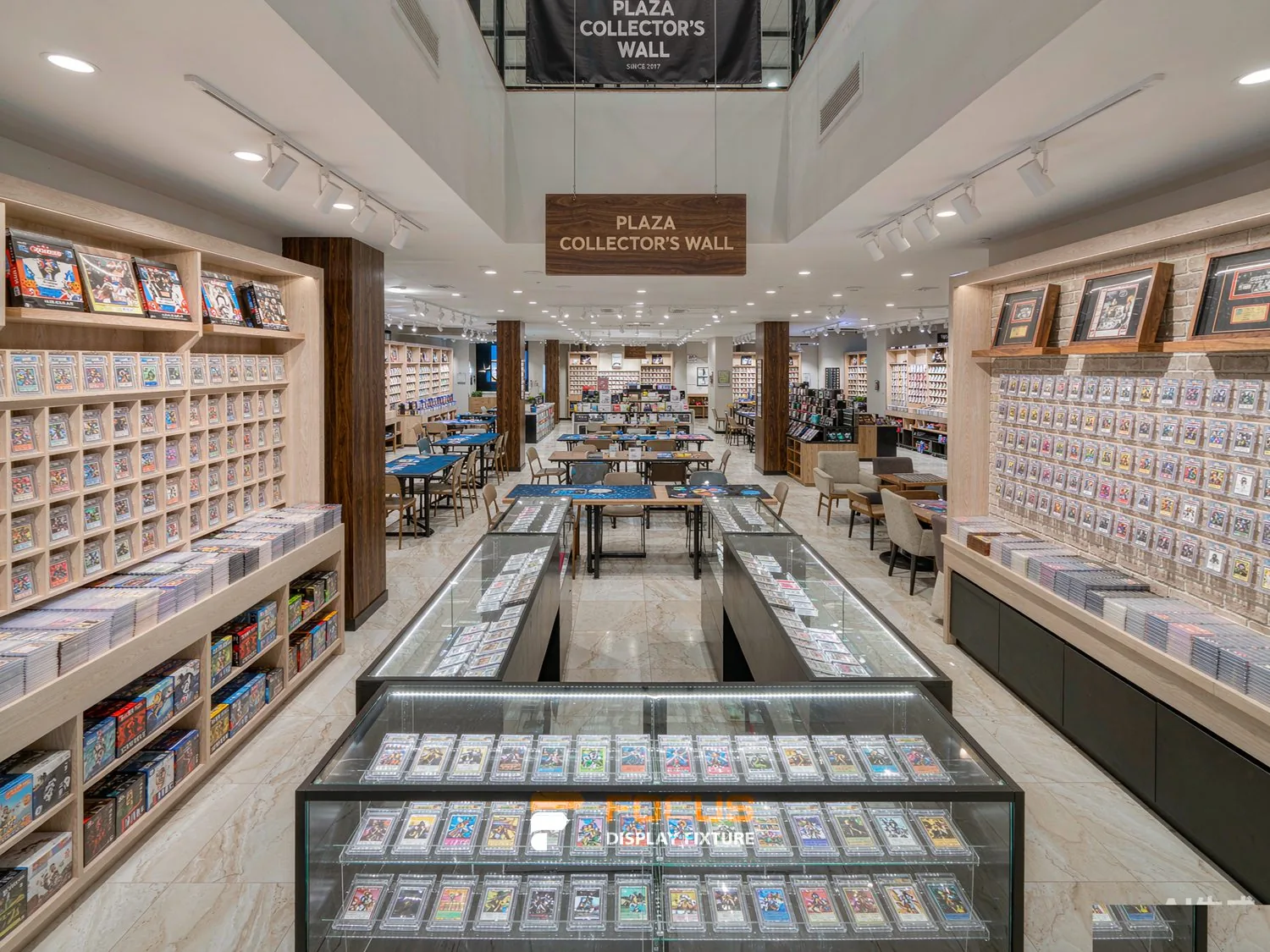
A tabletop card display stand creates a focal point for a small selection. A shelf or wall rack can organize a wider range by game, set or team. A glass counter display case supports a conversation while staff retrieve cards. Pick the format that serves the intended customer task; a dense wall is less useful if customers cannot identify the card or ask for the correct position.
Plan viewing height and readable groups
Group cards by a clear theme and leave enough separation for names and prices. Review the arrangement standing and seated, then look at the lowest and highest rows. For a shop, keep browsing space clear of checkout queues and show where a member of staff sets down a retrieved card. At home, choose a stable surface away from accidental handling and direct sunlight.
Treat light exposure as a separate decision
An attractive illuminated case does not prove preservation performance. The Library of Congress identifies light exposure as a collection-care risk. Limit unnecessary display exposure, avoid direct sunlight and ask for evidence behind specific glazing claims. For sensitive or high-value material, obtain advice for the actual card, ink, holder and display conditions rather than assuming one glazing specification protects every collection.
Approve one complete display before repeating it
Build one representative row or tray using your widest and tallest protected cards. Check the support lip, labels, reflections, stability and removal path. Photograph the accepted arrangement and record the clear dimensions. For custom fixtures, include the number of usable positions, spare trays and replacement components in the quote so future orders can repeat the same layout.
Translate the guidance into a specification check.
These parameters connect the article to a real product and give procurement, design and engineering teams one reviewable basis.
Compare one controlled basis.
How we apply this decision.
Use a representative merchandise sample and a measured plan. Record the approved arrangement before ordering custom fixtures.
Review FOCUS capabilities →What still needs project confirmation.
Editorial planning guidance. Images illustrate supplied design references; dimensions, performance, commercial outcomes and local compliance are confirmed separately for each project.
Prepare the required inputs →Avoid these shortcuts.
- Treating a reference image as an approved production specification.
- Comparing suppliers without identical dimensions, quantities and delivery scope.
- Separating material, lighting or hardware decisions from the drawing revision.
- Leaving packing, local installation and site interfaces undefined.
Before the next approval.
- Start with cards in their actual holders
- Compare stands, shelves, wall rows and counters
- Plan viewing height and readable groups
- Record each open point, owner, due date and required evidence.
Answers to the next practical questions.
01Trading Card Display Ideas — where should I start?+
Choose a trading card display by protected-card size, viewing position and access rule. Open stands suit a small rotating selection; wall rows suit browsing; counter cases suit staff-assisted viewing. Keep cards in appropriate holders and check lighting separately from display appearance.
02What should the approval record include?+
Use a representative merchandise sample and a measured plan. Record the approved arrangement before ordering custom fixtures.
Trace the supporting information.
Ultra PRO: trading-card toploaders ↗Manufacturer reference for protective-holder formats. Cabinet clearance is measured from the complete holder and sleeve.
Library of Congress: limiting light damage ↗General collection-care context; material-specific conservation advice is separate from retail fixture selection.
Content review policyGuidance published 2026-11-03. Editorial check: 2026-11-03. Project engineering approval and physical testing are separate.
Move from research to a project decision.
Get a project-specific recommendation.
Send your store plan, product sizes, fixture quantities, destination and opening target. FOCUS will identify the product fit, engineering inputs and quotation basis.
Start Your Display Project